Recently I attended the TSA (check out the freebie page, it’s good) Pursuit of Strength seminar. Each of the 5 coaches presented on a separate topic: Bryce Lewis’s was based around Sports Psychology, and touched mainly on motivation.
One of the areas discussed was Self Determination Theory (SDT);
SDT is “a macro theory of human motivation and personality that concerns people’s inherent growth tendencies and innate psychological needs. It is concerned with the motivation behind choices people make without external influence and interference. SDT focuses on the degree to which an individual’s behavior is self-motivated and self-determined”
SDT revolves around the belief that human nature exhibits persistent positive features, that show effort, agency and commitment in life that the theory refers to as ‘inherent growth tendencies’. People have innate psychological needs that are the basis for self motivation and personality integration.
What I’d like to take a look at is how we can look at this in an actionable context within powerlifting, the ways I implement this with my lifters and myself and how you might be able to implement something yourself. This will involve straying away from the confines of Self Determinism Theory and involve looking at other theories of behaviour within the categories SDT outlines (competence, relatedness and autonomy). There’s a chance I’ll misapply something here and there; it’s been almost a decade since I looked at motivational theory in any depth so my knowledge is a bit rusty, but hopefully there will be plenty of thought provoking ideas that can be actionable within your training and/or coaching.
SDT identifies three innate needs that, if satisfied, allow optimal function and growth:
Competence: Seeking to control the outcome and experience mastery
Relatedness: The universal want to interact, be connected to, and experience caring for others
Autonomy: The universal urge to be causal agents of one’s own life and act in harmony with one’s integrated self; however, Deci and Vansteenkiste note this does not mean to be independent of others
These needs are seen as universal necessities that are instinctually present, and persistent across age, gender, culture etc.
To actualise their inherent potential they need nurturing from the social environment. If this happens there are positive consequences (e.g. well being and growth) but if not, there are negative consequences.
So SDT emphasises humans’ natural growth toward positive motivation; however, this is thwarted if their basic needs are not fulfilled.
Act I: Competence.
Competence: Seek to control the outcome and experience mastery.
The most obvious way we can work towards this whilst powerlifting is to gain mastery over the technique we use whilst lifting. Gaining competence over something is incredibly rewarding, but the opposite is true too. If we lack the skill level necessary to perform a task it can be incredibly demotivating to keep butting your head against the wall and feeling like you’re not getting better.
We need to be mindful of this when prescribing supplementary and accessory work. If we’re meant to be doing single leg RDL’s and keep falling over because we’re losing balance, or doing pin squats but forever letting the hips shoot and we’re good morning-ing the bar instead then it can be very demoralizing.
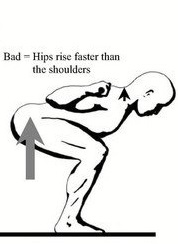 This is not my happy place
Make sure you’re building in opportunities to take the win where possible so you can feel competent! Set competence related goals, and celebrate when they’re met.
Let’s take a look at some theory as it relates to competence and motivation.
In 1959 Robert White coined the term ‘effectance’, defining it as the tendency to explore and influence our environment, arguing that organisms are intrinsically motivated to interact with their physical and social environment, If these interactions are successful it results in intrinsic rewards like feelings of efficacy and pleasure, and these motivate further efforts.
Whites theory was considered a novel approach at the time as it differed from popular traditional drive theories of human behaviour, and from the psychoanalytical instinct theory popularised by Freud (no longer was fancying your mum your sole reason for doing something).
 Sometimes I dream about banging your mum.
In the late 1970s, Susan Harter extended White’s theory to develop a more complete framework that she initially identified as effectance motivation theory but was later more commonly referred to as competence motivation theory. Similar to White, Harter also identified enjoyment as the reason individuals interact with their environment, but also expanded the idea to how effectance, or competence motivation, can vary across achievement domains such as physical, social, or mental. In each, individuals are motivated to engage in mastery attempts, for the purpose of developing or demonstrating competence. If successful at an optimally challenging task and they receive socio-emotional support from significant individuals, they will experience perceptions of of competence and performance control. This is why it’s a big deal when Boris Sheiko compliments your technique. Or upper:lower arm ratio.
 please adopt me
High perceptions of competence and control result in feelings of pleasure that lead to maintenance of, or an increase in competence motivation.
In contrast to White, Harter also proposed that there was a negative response component: engaging and then failing in a mastery attempt, and not receiving praise from a significant individual (or receiving disapproval) will lead to decreased perceptions of competence and control in, along with anxiety and shame. This combination of events will lead to decreased effectance motivation in that particular domain.
So how do we make this actionable in our approach to powerlifting?
Firstly, for long term development we need to look at our training with a focus on developing competency, and rewarding competence mastery – i.e work on your technique and focus the ‘wins’ on how well you’re moving as much as we focus on the ‘win’ of the PB weight.
Avoid programming exercises we have little competence with. Not only does performing something you’re really bad at feel physically bad, but it’s also mentally draining and demoralising. As powerlifters we NEED to perform the competition lifts at some point in our training, but we have a cornucopia of assistance & accessory movements to choose from. So long as we’re picking a decent tool for the job, picking the movements the lifter actually enjoys is going reap far more benefits than something they hate. Offering the chance to work on that suitably difficult but still surmountable challenge will have a great impact on adherence and motivation.
Stay tuned for parts 2 and 3 where I’ll go over Autonomy and Relatedness.
If a guided approach to developing competence as a powerlifter sounds good, get in touch. I’ve currently got a few spaces left for one-to-one weekly online coaching.
If you liked this, I’d be very grateful if you could share it on your favourite social media.
 Graft Training Principles
One thought on “Self Determinism Theory and Powerlifting pt 1”